



8 OrganTech's Vision
— Toward a Healthy Society Where People Live with Their Own Teeth —

Ph.D. in Science from Kyushu University Graduate School. Has held positions including Professor at Tokyo University of Science, Team Leader at RIKEN BDR, and others. Currently Visiting Professor at Tokyo Dental College and Visiting Senior Scientist at RIKEN. Founded OrganTech in 2008 and became Chairman in 2024. View full profile >
The daily act of eating relies on oral functions such as "mastication" (chewing food with teeth) and "deglutition" (swallowing), playing a critical role in maintaining overall health and quality of life (QOL), as well as in realizing a healthy, long-lived society. In particular, chewing with one's own natural teeth not only provides the "joy of eating" but also functions to buffer masticatory shock and enable occlusal perception. Furthermore, recent studies suggest it enhances cognitive function by increasing cerebral blood flow. Intraoral infections arising from dental diseases, such as periodontal disease, are no longer viewed as localized conditions; they are increasingly recognized for their link to systemic diseases. Consequently, tooth-centered oral hygiene has emerged as a significant public health challenge.
For this reason, dental treatment has been practiced since ancient times. A recent paper suggested that a Neanderthal from 59,000 years ago may have treated dental caries using stone tools, which represents the oldest known instance of dental intervention. Regarding modalities for tooth loss, historical records indicate the use of wooden full dentures by a Buddhist nun during Japan's Sengoku (Warring States) period, and wire-fixed bridges dating back to the fifth century BCE (Special Feature, Chapter 2). Furthermore, early dental implants utilizing mother-of-pearl were documented in the Maya civilization around the seventh century CE, with reports indicating they achieved osseointegration. While these treatment modalities continue to evolve today, the dental implant is currently considered the most effective option for addressing tooth loss.
While dental implants are highly effective in restoring occlusal function and esthetics, they lack a periodontal ligament. Consequently, they are devoid of the inherent biological functions of a natural tooth, such as occlusal shock absorption, sensory perception, infection defense via immunocompetent cells, and tooth mobility. To address these limitations of tooth loss, we have aimed for true "tooth regeneration"—effectively creating a "third dentition" for human patients—by fully restoring these biological functions.
As described in the Special Feature (Chapter 3), our challenge made a global impact by demonstrating that a "bioengineered tooth" could be fully regenerated by completely recapitulating tooth development, resulting in full functional recovery. Furthermore, as a next-generation advancement over current treatments, we developed the Bio-hybrid Tooth. By equipping a dental implant with a periodontal ligament, it serves as a functionally enhanced tooth immune to dental caries, while biologically possessing full biological functions as a next-generation osseointegrated implant. The Bio-hybrid Tooth lies on the continuum of modern dental implant therapy, making its development highly feasible as a practical clinical option today. By providing a third dentition, we aim to realize a healthy, long-lived society where patients can chew with their own natural teeth.
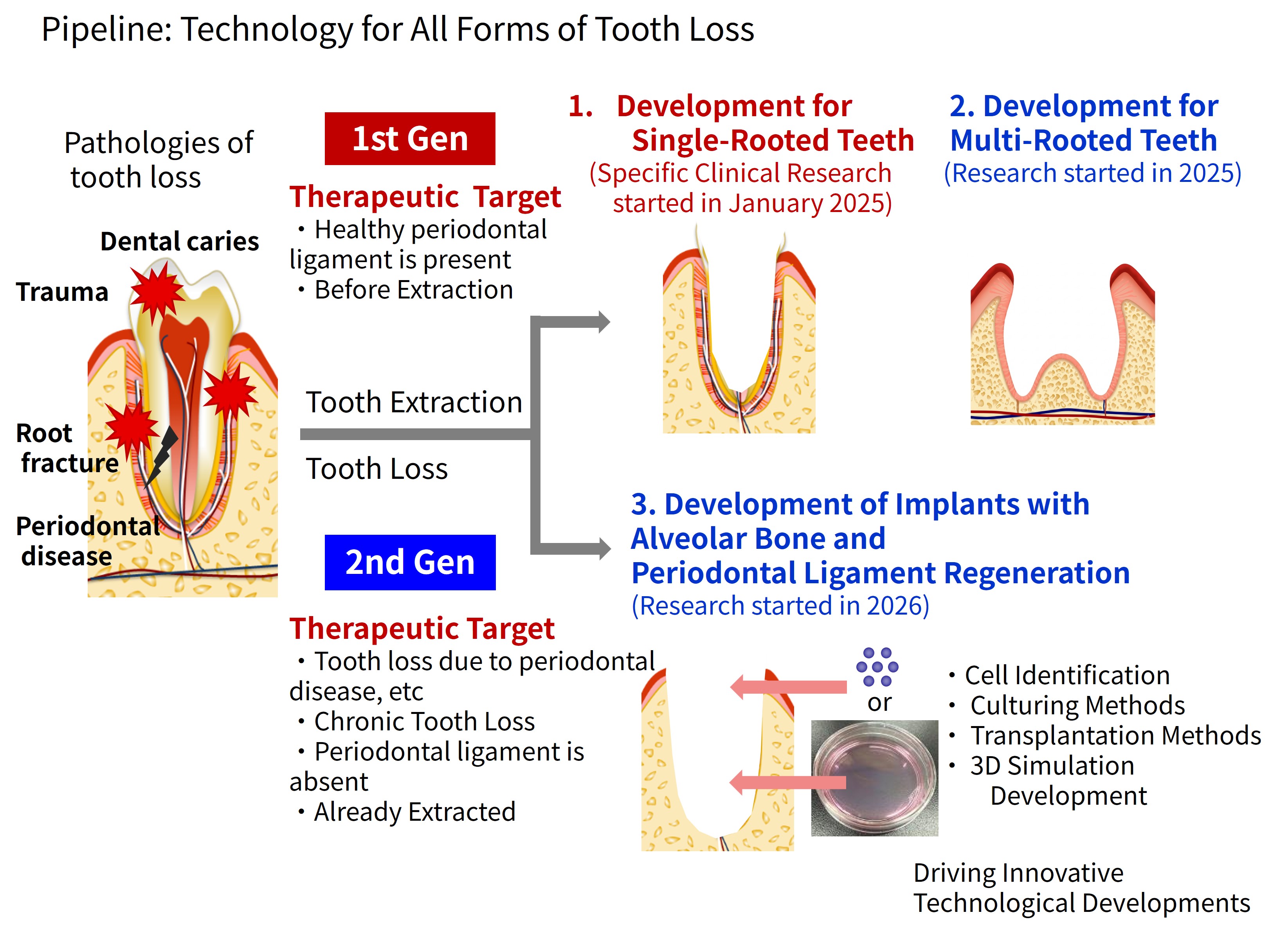
Clinical research on the Bio-hybrid Tooth has commenced with the "First Generation," which targets single-rooted teeth where the patient's own natural periodontal ligament can be utilized following extraction due to root fracture or severe caries. Moving forward, we will advance toward developing treatment modalities for multi-rooted teeth, such as molars, and the "Second Generation" Bio-hybrid Tooth for cases where the patient's own periodontal ligament is unavailable due to conditions like periodontal disease. (Figure 1)
At OrganTech, Inc., we are committed to contributing to the maintenance and improvement of health and QOL, and to the realization of a healthy, long-lived society through the core element of a healthy life: "chewing and eating with one's own natural teeth."
