



Chapter
2 Treatment Options After Tooth Loss
— The Current State and Limitations of Dental Implants
2 Treatment Options After Tooth Loss
— The Current State and Limitations of Dental Implants
Last updated: February 10, 2026

Miho Ogawa, Ph.D. Director, CTO
Ph.D. in Science from Tokyo University of Science Graduate School. After working at Otsuka Holdings and RIKEN, became Director and CTO of OrganTech Inc. Promotes research, development, and commercialization in regenerative medicine and organ induction. Recipient of the Japan Sjögren's Syndrome Society Award and the Economist Future Award 2023 SDGs Division. View full profile >
Ph.D. in Science from Tokyo University of Science Graduate School. After working at Otsuka Holdings and RIKEN, became Director and CTO of OrganTech Inc. Promotes research, development, and commercialization in regenerative medicine and organ induction. Recipient of the Japan Sjögren's Syndrome Society Award and the Economist Future Award 2023 SDGs Division. View full profile >
The Evolution of Dental Treatment to Restore the Ability to Chew
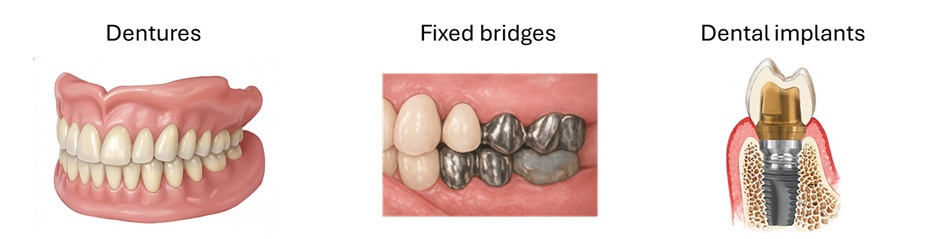
When a tooth is lost, everyday activities such as chewing and eating become difficult. For this reason, dentistry has long sought ways to restore lost tooth function throughout its history. Dentures, bridges, and dental implants (Figure 1) have all been developed for this purpose. As treatment methods have evolved over time, creating a condition in which people can "chew again" has now become almost routine. This represents one of the major achievements of dental medicine in supporting people's daily lives.
Figure 1 Artificial dental treatments for tooth loss
A Major Advancement Brought by Dental Implants
Among these treatments, dental implant therapy has marked a significant step forward in the management of tooth loss. This approach involves fixing a metal implant into the jawbone and placing an artificial tooth on top of it. Dental implants have improved quality of life for many people because they:
・ do not require grinding down surrounding healthy teeth,
・ provide stable and strong chewing function, and
・ offer a natural appearance.
"The ability to eat as before, even after losing a tooth" — this has become a reality for many patients. In this sense, dental implants represent a groundbreaking option in modern dental treatment.
・ do not require grinding down surrounding healthy teeth,
・ provide stable and strong chewing function, and
・ offer a natural appearance.
"The ability to eat as before, even after losing a tooth" — this has become a reality for many patients. In this sense, dental implants represent a groundbreaking option in modern dental treatment.
Remaining Differences from a Natural Tooth
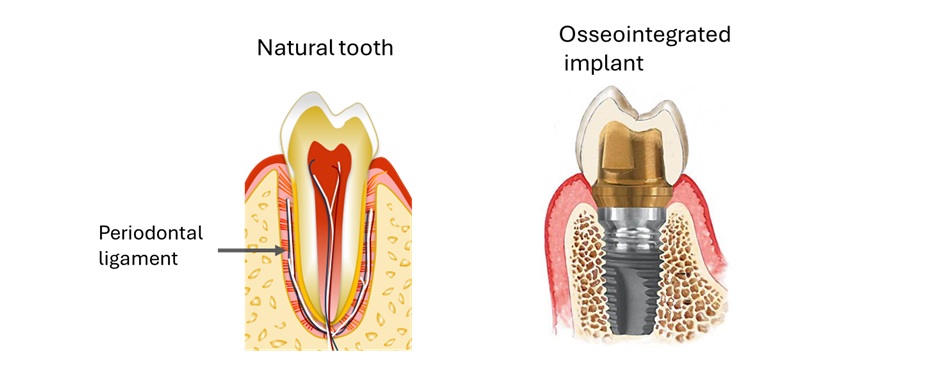
Despite these advances, dental implants do not have the same structure as a natural tooth (Figure 2). As introduced in Chapter 1, natural teeth are connected to the Alveolar bone by the Periodontal ligament.
The Periodontal ligament plays many important roles, including:
・ gently absorbing chewing forces,
・ sensing bite pressure and subtle discomfort,
・ protecting both the tooth and the bone, and
・ adapting to slight tooth movement that occurs with aging.
However, current dental implants are designed so that the artificial root bonds directly to the bone and therefore do not have a Periodontal ligament. As a result, while implants can restore the ability to chew, they do not fully reproduce all of the physiological functions originally possessed by a Natural tooth. This limitation remains one of the key challenges of implant therapy today.
The Periodontal ligament plays many important roles, including:
・ gently absorbing chewing forces,
・ sensing bite pressure and subtle discomfort,
・ protecting both the tooth and the bone, and
・ adapting to slight tooth movement that occurs with aging.
However, current dental implants are designed so that the artificial root bonds directly to the bone and therefore do not have a Periodontal ligament. As a result, while implants can restore the ability to chew, they do not fully reproduce all of the physiological functions originally possessed by a Natural tooth. This limitation remains one of the key challenges of implant therapy today.
Figure 2 Periodontal ligament in natural teeth and implants
Beyond "Replacement" Toward the Next Stage
Modern dentistry has successfully evolved to the point where chewing function can be restored even after tooth loss. The next question is: what should we aim for next? Is it possible to recover not only chewing strength, but also the sensory functions and protective mechanisms that Natural teeth once had?
In response to this question, a new concept has emerged: the regeneration of the tooth itself.
In the next installment, Chapter 3, we will introduce OrganTech's ongoing challenge to "regenerate teeth," exploring its underlying ideas and future potential.
In the next installment, Chapter 3, we will introduce OrganTech's ongoing challenge to "regenerate teeth," exploring its underlying ideas and future potential.
