



7 Bio-hybrid Tooth
— Development and Clinical Research Toward Human Application —

Ph.D. in Science from Kyushu University Graduate School. Has held positions including Professor at Tokyo University of Science, Team Leader at RIKEN BDR, and others. Currently Visiting Professor at Tokyo Dental College and Visiting Senior Scientist at RIKEN. Founded OrganTech in 2008 and became Chairman in 2024. View full profile >
Teeth are closely associated with essential human functions such as mastication and speech, and tooth loss or functional impairment represents a major issue affecting quality of life (QOL). In Japan, a super-aging society, the importance of dental treatment continues to increase in pursuit of healthy longevity.
Conventional dental treatments for tooth loss—including dentures, bridges, and osseointegrated implants—have primarily restored masticatory function, occlusion, and esthetics, thereby contributing significantly to improved QOL. The ultimate goal of dental therapy for tooth loss is the realization of a “third dentition” following primary and permanent teeth: regeneration of a patient’s own tooth possessing not only functional and esthetic properties but also intrinsic biological functions.
As one approach toward this goal, we have developed a Bio-hybrid tooth endowed with a periodontal ligament.
In addition to proof-of-concept studies in mice, extensive histological analyses, mobility assessments, and systemic examinations were conducted using large animal models (dogs), demonstrating sufficient non-clinical efficacy and safety (see Chapter 6 of this special series). Parallel to these non-clinical canine studies, research and development proceeded toward human clinical application.
Unlike experimental animal models such as mice and dogs—where body size, tooth position, and experimental parameters are standardized—humans exhibit substantial individual variability, including body size, tooth morphology, alignment, and treatment history. Overcoming these individual differences is essential for clinical translation.
The hybrid tooth is inserted into the extraction socket. Because extraction socket dimensions vary depending on tooth position and individual anatomy, a lineup of 16 implant sizes with different diameters and lengths was prepared in collaboration with an implant manufacturer. Furthermore, appropriate occlusal stimulation is required to induce engraftment and maturation of the periodontal ligament. Therefore, a minimally invasive implantation device was developed for human application that allows occlusal stimulation to be transmitted from adjacent teeth. This implantation device is custom-made according to tooth position and the condition of neighboring teeth affected by previous treatments.
Another critical consideration is preventing damage to the alveolar bone wall—where the periodontal ligament attaches—within the extraction socket. Proper implant depth, length, and diameter must therefore be selected and fixed within the implantation device, followed by adjustment to apply optimal occlusal loading. Root morphology and dimensions were simulated with the cooperation of a dental laboratory before fabrication of the implantation device.
At this stage, preparation for human trials was finally completed. Sixteen years had elapsed since the initiation of research on the periodontal ligament–integrated implant (product name: Bio-hybrid Tooth).
On January 29, 2025, the launch of a specified clinical study was announced—the world’s first attempt at organ regeneration therapy for tooth loss—to evaluate the safety and efficacy of the periodontal ligament–integrated implant (press release).
The development company was OrganTech, Inc., and the clinical study site was the Dental and Maxillofacial Implant Center at the Southern Tohoku Medical Clinic, affiliated with the Southern Tohoku General Hospital, Institute of Neuroscience.
The principal investigator, Dr. Shohei Kasugai, had long been a key research partner since his tenure as Professor of Implant Dentistry at Tokyo Medical and Dental University Hospital (currently Institute of Science Tokyo), making him ideally suited to lead this clinical study. Associate Professor Masamitsu Oshima of Tokushima University Graduate School also joined the study, having collaborated since earlier research periods at Tokyo University of Science and RIKEN.
The study design is summarized below.
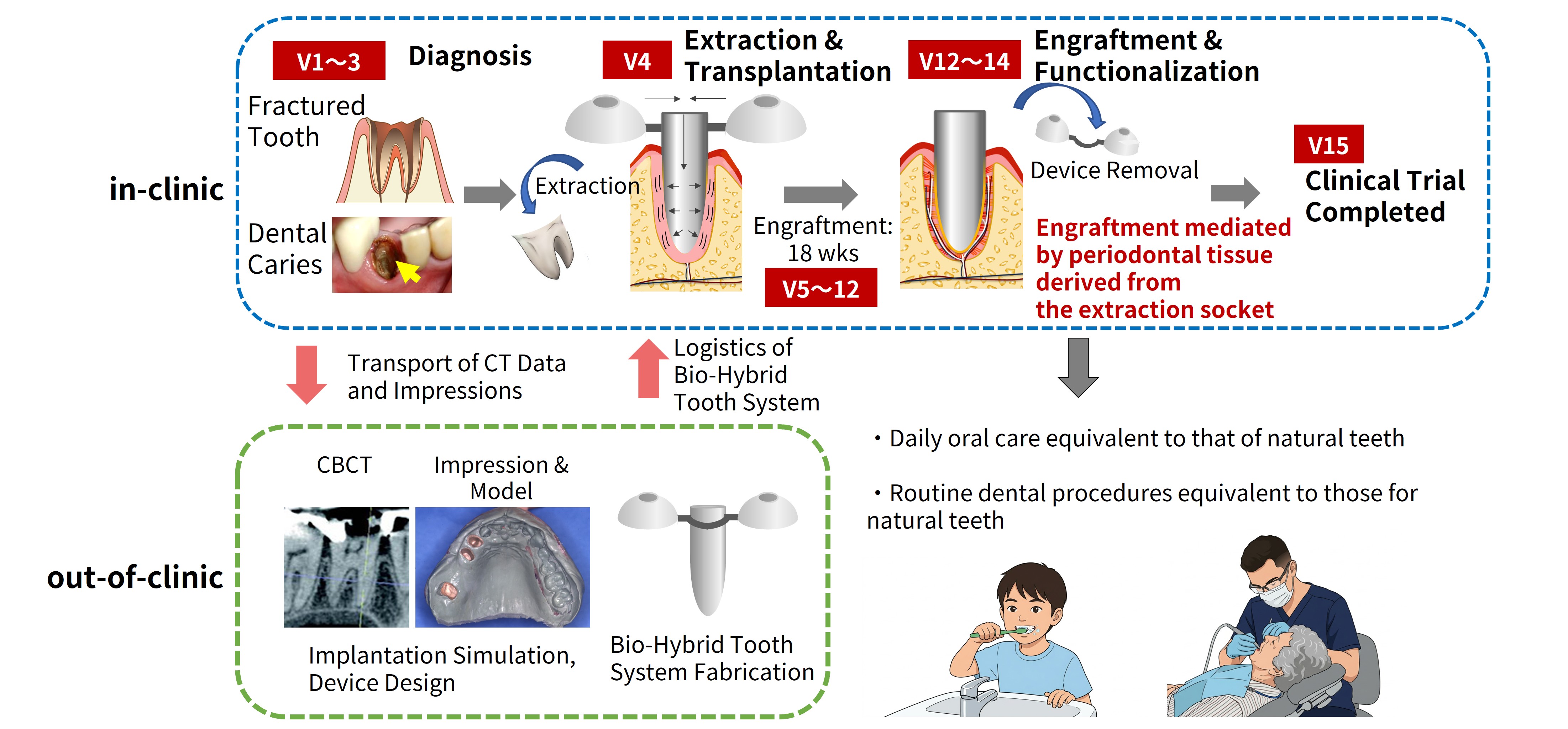
During the first three visits, patient eligibility for the treatment is evaluated, and the optimal implant is selected for the tooth scheduled for extraction. A fixation device connecting the implant and adjacent teeth is then fabricated.
At the fourth visit, tooth extraction and simultaneous placement of the implant and fixation device are performed. Until 18 weeks post-transplantation, follow-up examinations evaluate implant engraftment and periodontal ligament formation. Between weeks 18 and 36, the fixation device is removed, and treatment is completed at 48 weeks post-transplantation. The specified clinical study officially commenced on February 1, 2025.
On March 16, 2026, an interim progress report was released by the medical institution. Patient enrollment had been completed in October 2025, and four patients received periodontal ligament–integrated implants. By March 16, three patients had completed 24-week engraftment evaluations, while the remaining patient had also completed evaluation. All cases demonstrated clinical parameters comparable to a natural tooth, and successful engraftment to the jawbone was confirmed. During the observation period, no adverse events such as swelling, bleeding, gingival recession, or pain were reported. These findings suggest that periodontal ligament–integrated implants may represent a minimally invasive and safe implant therapy according to predefined clinical evaluation criteria. Final efficacy and safety assessments are scheduled at 44–48 weeks.
Although interim results from human studies indicate promising efficacy of the Bioengineered tooth concept, clinical application has only just begun. Because patients present with diverse dental conditions and lifestyles, continued humble and rapid research and development are essential to ensure that this therapy can benefit as many individuals as possible.
Together with dental professionals, we aim to advance the future of dental treatment through regenerative dentistry.
