



Chapter
6 Bio-hybrid Tooth
- An Implant That Restores Natural Tooth Function
6 Bio-hybrid Tooth
- An Implant That Restores Natural Tooth Function
Last updated: April 10, 2026

Miho Ogawa, Ph.D. Director, CTO
Ph.D. in Science from Tokyo University of Science Graduate School. After working at Otsuka Holdings and RIKEN, became Director and CTO of OrganTech Inc. Promotes research, development, and commercialization in regenerative medicine and organ induction. Recipient of the Japan Sjogren's Syndrome Society Award and the Economist Future Award 2023 SDGs Division. View full profile >
Ph.D. in Science from Tokyo University of Science Graduate School. After working at Otsuka Holdings and RIKEN, became Director and CTO of OrganTech Inc. Promotes research, development, and commercialization in regenerative medicine and organ induction. Recipient of the Japan Sjogren's Syndrome Society Award and the Economist Future Award 2023 SDGs Division. View full profile >
In Chapter 5, we introduced that by using dental follicle tissue present during the fetal stage, it is possible to reproduce around an implant the same structure found in a natural tooth, consisting of:
• Cementum
• Periodontal ligament
• Alveolar bone
In other words, it was scientifically demonstrated that an implant connected to bone through a periodontal ligament can be realized.
However, this method had a major challenge.
The issue was that it used fetal-derived tissue.
In actual medical care, treatments must:
• Be usable by anyone
• Be safely provided
Because dental follicle tissue exists only during the fetal stage, directly applying it to treatment is not realistic.
This leads to a new question:
"Can the same result be achieved using only what already exists inside the body?"
• Cementum
• Periodontal ligament
• Alveolar bone
In other words, it was scientifically demonstrated that an implant connected to bone through a periodontal ligament can be realized.
However, this method had a major challenge.
The issue was that it used fetal-derived tissue.
In actual medical care, treatments must:
• Be usable by anyone
• Be safely provided
Because dental follicle tissue exists only during the fetal stage, directly applying it to treatment is not realistic.
This leads to a new question:
"Can the same result be achieved using only what already exists inside the body?"
Using the "Periodontal ligament" remaining after tooth extraction
When a tooth is extracted, the Periodontal ligament does not completely disappear.
In reality, most of it remains inside the extraction socket. Within this tissue, cells believed to regenerate the periodontal ligament are thought to exist.
For this reason, OrganTech, Inc. focused on a method that utilizes the periodontal ligament remaining in the extraction socket.
In reality, most of it remains inside the extraction socket. Within this tissue, cells believed to regenerate the periodontal ligament are thought to exist.
For this reason, OrganTech, Inc. focused on a method that utilizes the periodontal ligament remaining in the extraction socket.
A new approach: “Letting the body heal itself”
The idea was very simple.
An implant capable of connecting with the periodontal ligament is placed into the extraction site, and an environment is created where forces are applied in the same way as to neighboring teeth. The concept is that the body recognizes this as a natural condition and reconstructs the periodontal ligament by itself.
This approach is based on biological thinking:
• Not artificially manipulating cells
• Using the body's natural healing ability
An implant capable of connecting with the periodontal ligament is placed into the extraction site, and an environment is created where forces are applied in the same way as to neighboring teeth. The concept is that the body recognizes this as a natural condition and reconstructs the periodontal ligament by itself.
This approach is based on biological thinking:
• Not artificially manipulating cells
• Using the body's natural healing ability
Verification under conditions close to humans — Dog study
To move this concept closer to real human treatment, verification was conducted using dogs, a large animal model with dental conditions similar to humans.
The results confirmed that the implant connected "like a Natural tooth" through periodontal ligament tissue.
The results confirmed that the implant connected "like a Natural tooth" through periodontal ligament tissue.
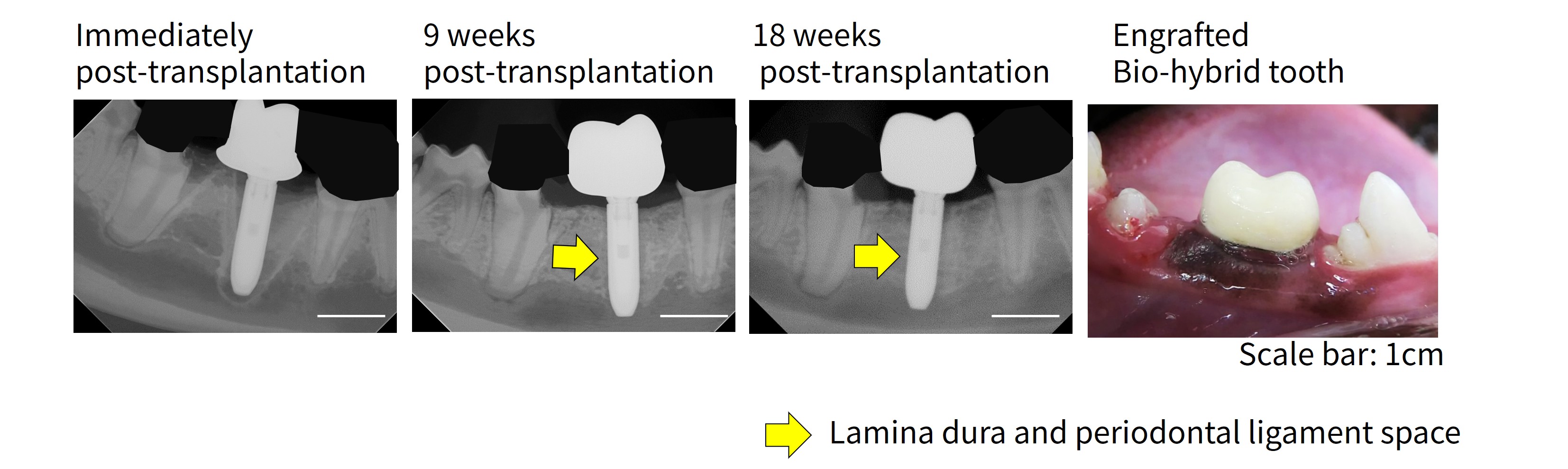
Figure 1 Dog-transplanted Bio-hybrid tooth
Detailed tissue examination showed:
• Cementum formed on the implant surface
• Periodontal ligament fibers (Sharpey's fibers) inserted into the surface
A periodontal ligament structure similar to that of a natural tooth was formed.
• Cementum formed on the implant surface
• Periodontal ligament fibers (Sharpey's fibers) inserted into the surface
A periodontal ligament structure similar to that of a natural tooth was formed.
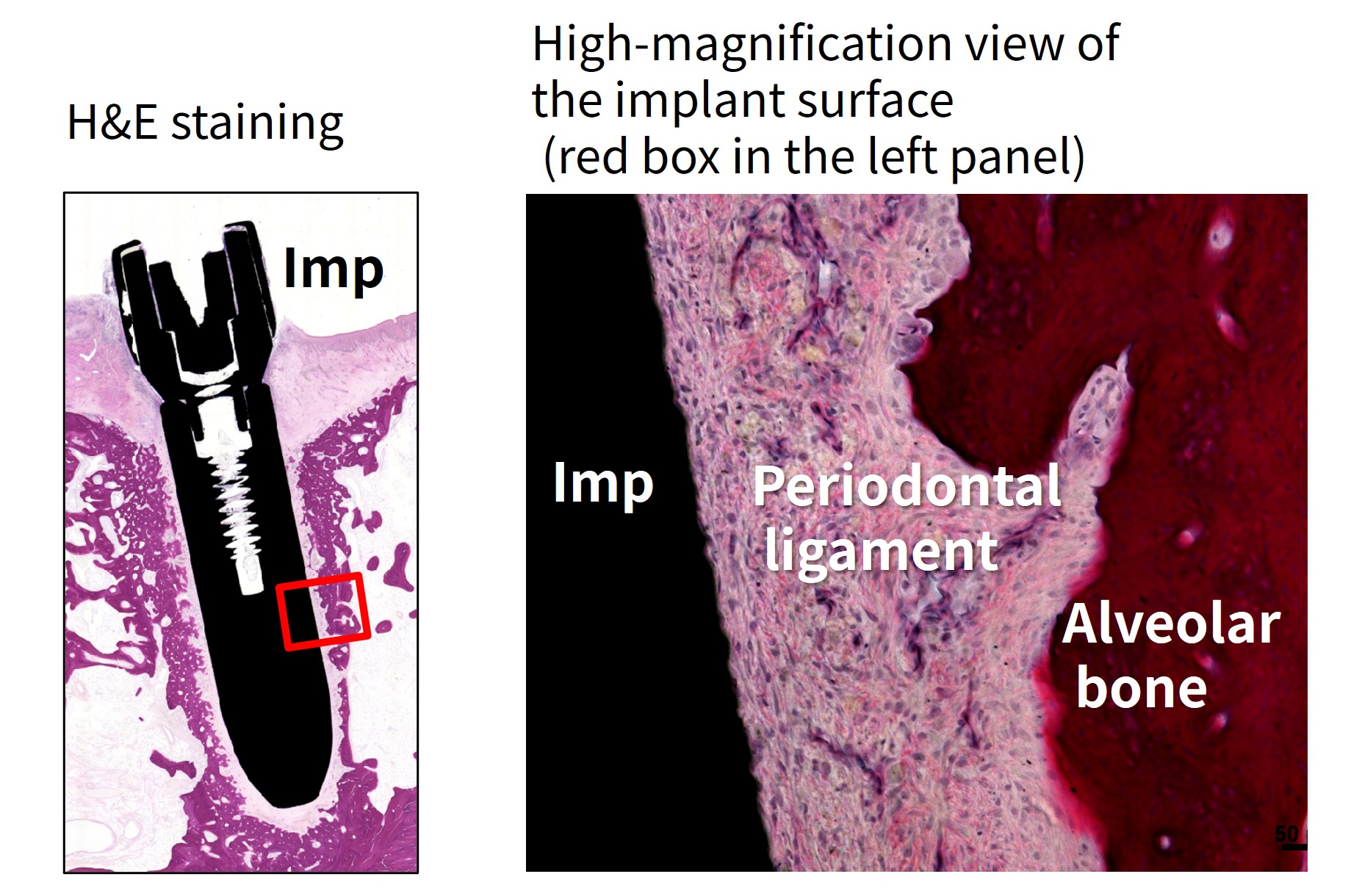
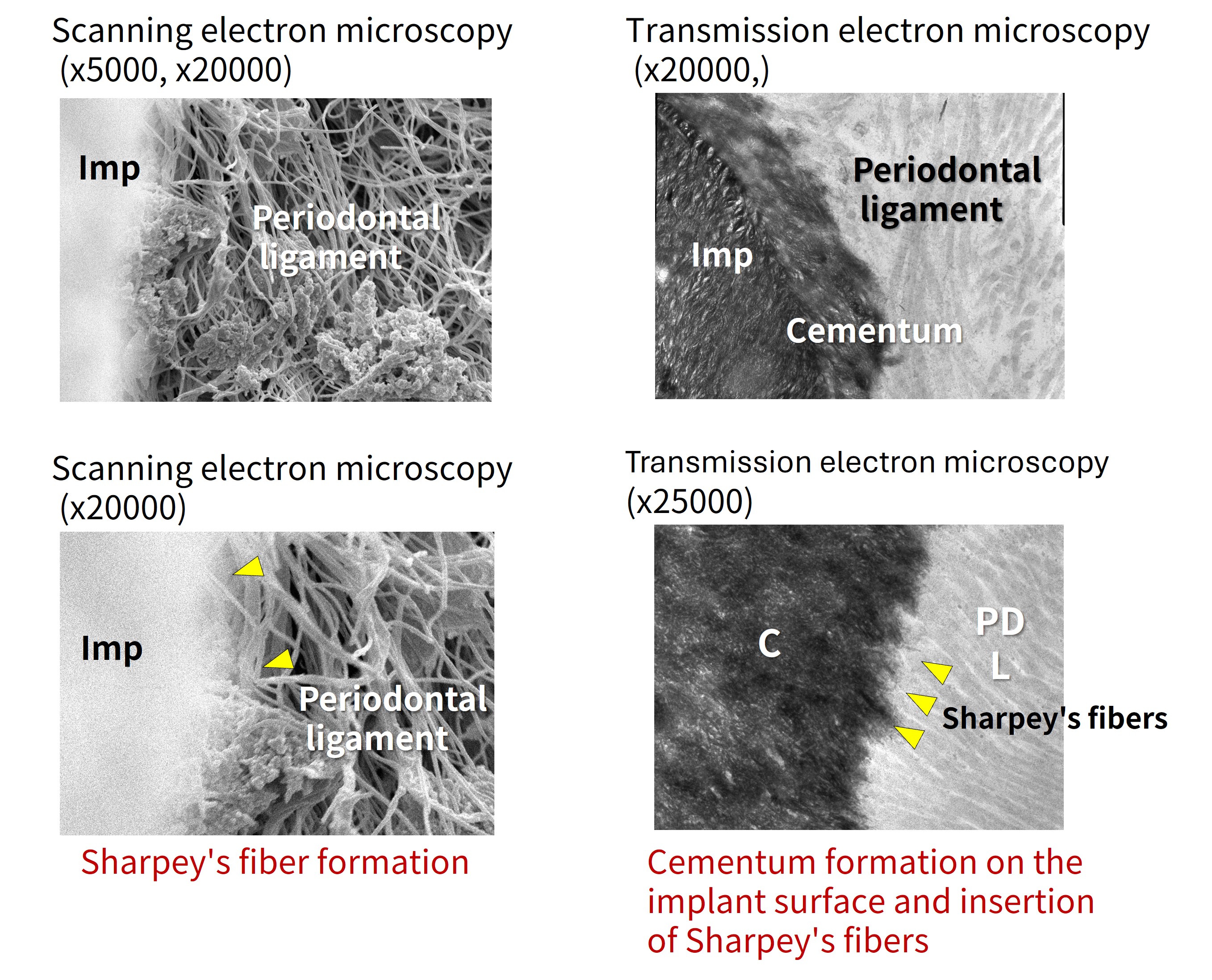
Figure 2 Histology of a Bio-hybrid implant transplanted into a canine model
Figure 3 Electron microscopy of a biohybrid implant transplanted into a canine model
Furthermore, an important functional result was obtained: mobility.
A conventional Osseointegrated implant directly bonds to bone and therefore does not move when force is applied.
However, this implant showed slight movement, similar to a natural tooth.
The measured mobility was within the same range as a Natural tooth.
This result indicates harmonious integration with the body through the Periodontal ligament.
A conventional Osseointegrated implant directly bonds to bone and therefore does not move when force is applied.
However, this implant showed slight movement, similar to a natural tooth.
The measured mobility was within the same range as a Natural tooth.
This result indicates harmonious integration with the body through the Periodontal ligament.
From “fixation therapy” to “harmonizing therapy”
Conventional implant treatment aims to firmly fix the implant to bone.
In contrast, this technology proposes a new concept:
An implant that works in harmony with surrounding tissues inside the body.
It represents a shift from “fixing” to “functioning as part of the living body.”
This is the concept of the Bioengineered tooth.
In contrast, this technology proposes a new concept:
An implant that works in harmony with surrounding tissues inside the body.
It represents a shift from “fixing” to “functioning as part of the living body.”
This is the concept of the Bioengineered tooth.
A question leading to the next chapter
Research in mice and dogs has brought implants possessing a periodontal ligament closer to reality.
When this technology becomes clinically available, how will dental medicine change?
In the next session, Chapter 7, we will introduce the future of dentistry brought by the Bioengineered tooth.
When this technology becomes clinically available, how will dental medicine change?
In the next session, Chapter 7, we will introduce the future of dentistry brought by the Bioengineered tooth.

* This article reflects research and development-stage information as of April 10, 2026, and does not represent finalized medical procedures or products.