



Chapter
3 OrganTech's Challenge (1)
— Regenerating Teeth
3 OrganTech's Challenge (1)
— Regenerating Teeth
Last updated: February 27, 2026

Miho Ogawa, Ph.D. Director, CTO
Ph.D. in Science from Tokyo University of Science Graduate School. After working at Otsuka Holdings and RIKEN, became Director and CTO of OrganTech Inc. Promotes research, development, and commercialization in regenerative medicine and organ induction. Recipient of the Japan Sjögren's Syndrome Society Award and the Economist Future Award 2023 SDGs Division. View full profile >
Ph.D. in Science from Tokyo University of Science Graduate School. After working at Otsuka Holdings and RIKEN, became Director and CTO of OrganTech Inc. Promotes research, development, and commercialization in regenerative medicine and organ induction. Recipient of the Japan Sjögren's Syndrome Society Award and the Economist Future Award 2023 SDGs Division. View full profile >
Teeth Are Formed by a Determined Biological Mechanism, Not by Chance
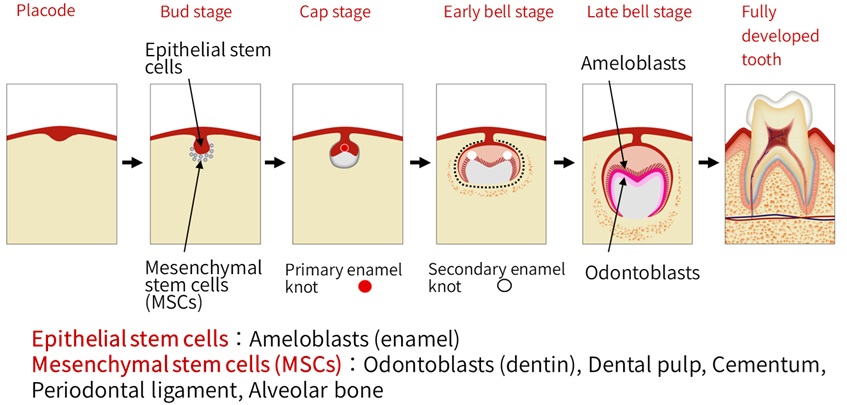
Although teeth appear to erupt naturally after birth, their preparation begins during the fetal stage. In the fetal oral cavity, two types of cells with distinct properties-Epithelial stem cells and Mesenchymal stem cells (MSCs)-interact with each other to form the tooth germ, the "seed of the tooth." As the tooth germ develops, Epithelial stem cells differentiate into Ameloblasts (enamel)-forming cells. In contrast, Mesenchymal stem cells (MSCs) differentiate into Odontoblasts (dentin), Dental pulp, and further into Periodontal tissues, including the Periodontal ligament, Cementum, and Alveolar bone, which support the tooth. Through these highly ordered processes of cell proliferation, migration, and differentiation within the tooth germ, the tooth is formed (Figure 1).
The number of teeth and the fact that teeth erupt only twice—deciduous and permanent dentitions—are also predetermined by the number of tooth germs. In other words, a tooth is an organ that the body itself designs and assembles.
The number of teeth and the fact that teeth erupt only twice—deciduous and permanent dentitions—are also predetermined by the number of tooth germs. In other words, a tooth is an organ that the body itself designs and assembles.
Figure 1 Tooth development
The Challenge of Artificially Creating the "Seed of a Tooth"
Can this tooth germ-the "seed of a tooth"-be artificially created?
The first initiative undertaken by OrganTech, Inc. was to isolate the two types of cells required for tooth development and recreate, outside the body, the environment in which a tooth can develop. Simply gathering cells does not result in tooth formation.
The critical factors are:
・which cells
・at which positions
・and at what density
they are arranged in three-dimensional space.
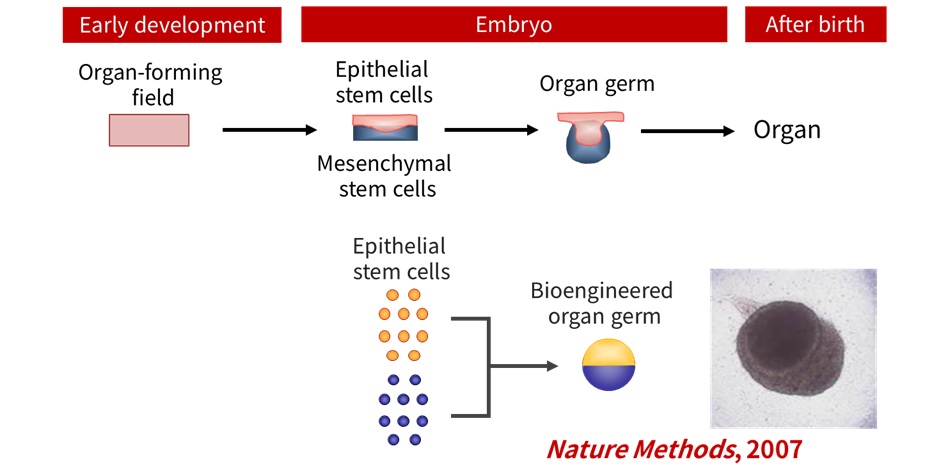
This challenge had remained unsolved for more than 30 years despite extensive research in developmental biology. After extensive trial and error, OrganTech, Inc. established a method in 2007 to arrange cells three-dimensionally. This technology is called the organ germ method (Figure 2).
This approach opened the way not only for tooth regeneration but also for the regeneration of various other organs.
The first initiative undertaken by OrganTech, Inc. was to isolate the two types of cells required for tooth development and recreate, outside the body, the environment in which a tooth can develop. Simply gathering cells does not result in tooth formation.
The critical factors are:
・which cells
・at which positions
・and at what density
they are arranged in three-dimensional space.
This challenge had remained unsolved for more than 30 years despite extensive research in developmental biology. After extensive trial and error, OrganTech, Inc. established a method in 2007 to arrange cells three-dimensionally. This technology is called the organ germ method (Figure 2).
This approach opened the way not only for tooth regeneration but also for the regeneration of various other organs.
Figure 2 Strategies and Achievements in Organ Regeneration Based
on Development and Regeneration
Demonstrating the Possibility of Regenerating Teeth That Can "Chew and Sense"
In 2009, it was demonstrated that this technology could achieve more than simple structural reconstruction.
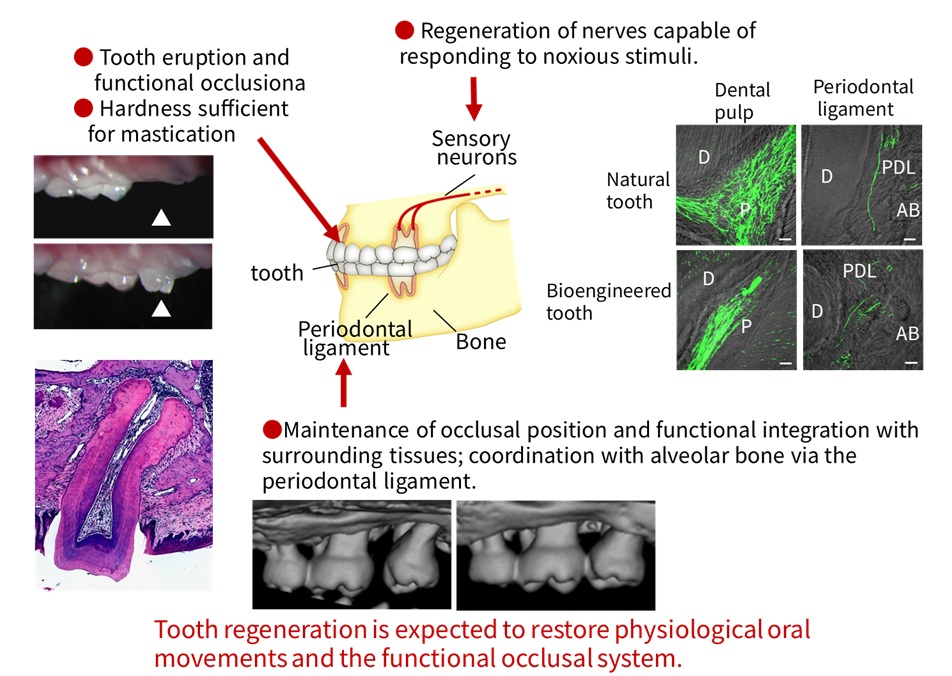
When a bioengineered tooth germ was transplanted into a site where a tooth had been lost, the tooth erupted naturally and achieved proper occlusion with the opposing tooth.
More importantly, the regenerated tooth demonstrated the same functions as a Natural tooth, including:
・connection to bone via the Periodontal ligament
・regulation of occlusal force
・movement in response to orthodontic force
・innervation by sensory Blood vessels and nerves, enabling perception of stimuli
(Figure 3)
These results indicated not merely the reproduction of tooth shape, but the possibility of regenerating the tooth as a fully functional organ.
When a bioengineered tooth germ was transplanted into a site where a tooth had been lost, the tooth erupted naturally and achieved proper occlusion with the opposing tooth.
More importantly, the regenerated tooth demonstrated the same functions as a Natural tooth, including:
・connection to bone via the Periodontal ligament
・regulation of occlusal force
・movement in response to orthodontic force
・innervation by sensory Blood vessels and nerves, enabling perception of stimuli
(Figure 3)
These results indicated not merely the reproduction of tooth shape, but the possibility of regenerating the tooth as a fully functional organ.
Figure 3 Functional Integration of the Regenerated Tooth in the
Maxillofacial Region
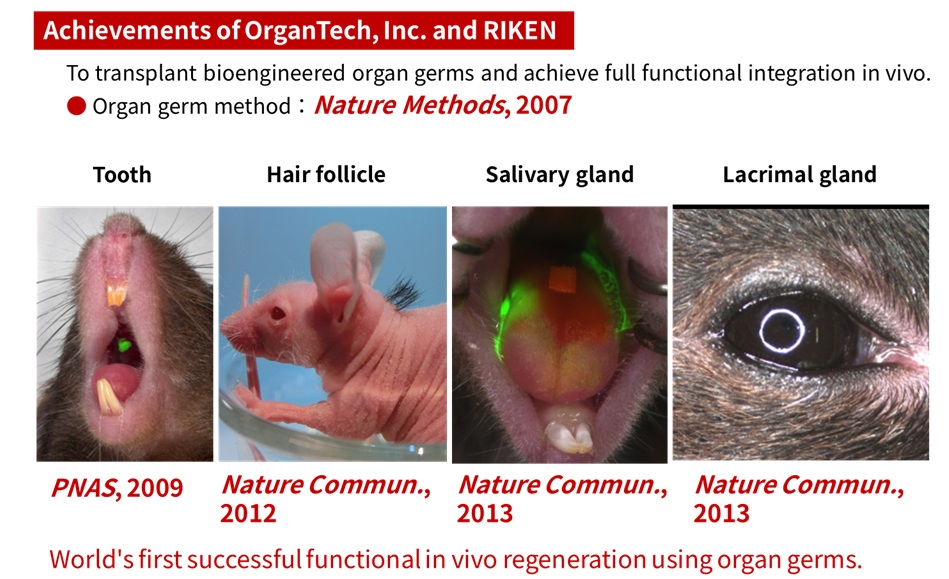
Using this organ germ method-based organ regeneration, we have also demonstrated the functional regeneration of hair follicles, salivary glands, and lacrimal glands in vivo. These achievements have opened new possibilities for future organ regenerative medicine and have had a significant global impact (Figure 4).
Figure 4 Strategies and Achievements in Organ Regeneration
Toward the Clinical Application of Regenerated Teeth
The successful regeneration of teeth in mice was a groundbreaking and highly significant achievement.
However, it also became clear that directly applying the tooth germ itself to human treatment would be difficult in practice. The tooth germ is a specialized structure formed during the fetal stage, and new concepts were required to translate this technology into clinical therapy.
In Chapter 4, we will introduce in detail the concept of a hybrid approach that combines biological systems and artificial materials, which was developed as a solution to this challenge.
However, it also became clear that directly applying the tooth germ itself to human treatment would be difficult in practice. The tooth germ is a specialized structure formed during the fetal stage, and new concepts were required to translate this technology into clinical therapy.
In Chapter 4, we will introduce in detail the concept of a hybrid approach that combines biological systems and artificial materials, which was developed as a solution to this challenge.

* This article reflects research and development-stage information as of February 27, 2026, and does not represent finalized medical procedures or products.