



1 Teeth at the Heart of a Healthy Society
— The Key Role of the Periodontal Ligament

Ph.D. in Science from Kyushu University Graduate School. Has held positions including Professor at Tokyo University of Science, Team Leader at RIKEN BDR, and others. Currently Visiting Professor at Tokyo Dental College and Visiting Senior Scientist at RIKEN. Founded OrganTech in 2008 and became Chairman in 2024. View full profile >
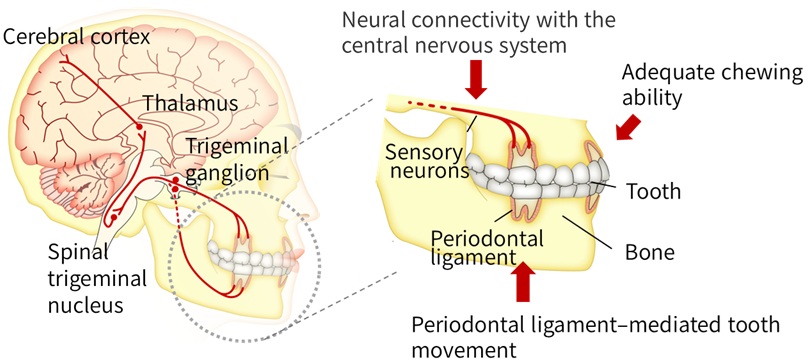
Everyday activities such as "eating," which involve oral functions including chewing (mastication) and swallowing (deglutition), play a critical role in maintaining and improving national health, quality of life (QOL), and the realization of a healthy longevity society. Among these, teeth and the periodontal tissues, in coordination with the craniofacial structures, establish the functional occlusal system responsible for mastication, speech, mandibular movement, and oral sensory perception, thereby playing a central role in oral function (Figure 1).
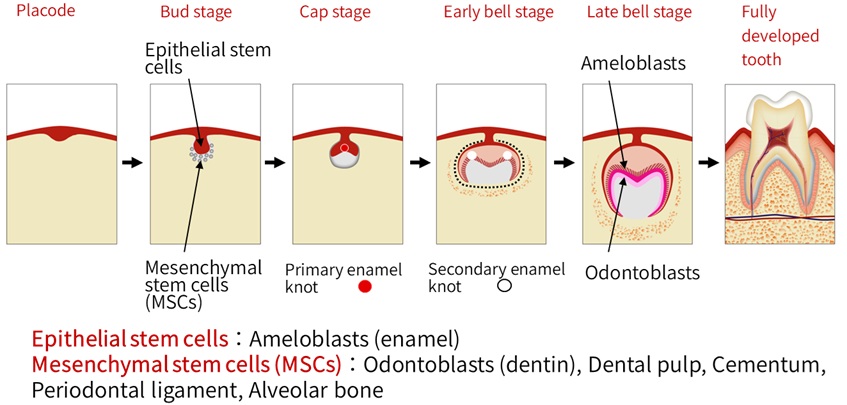
Teeth develop from tooth germs (primordia of teeth) induced through reciprocal interactions between epithelial stem cells and mesenchymal stem cells (MSCs) in the oral cavity during the fetal stage (Figure 2). Epithelial stem cells differentiate into ameloblasts (enamel)-forming cells. In contrast, mesenchymal stem cells (MSCs) differentiate into odontoblasts (dentin)-forming cells, as well as dental pulp cells and periodontal tissues. The periodontal tissues consist of the periodontal ligament, cementum, and alveolar bone. It is well established that the number of teeth and the number of tooth replacement cycles are determined by the number of tooth germs. In humans, two sets of tooth germs are induced during fetal development, giving rise to deciduous teeth and permanent teeth; thus, tooth eruption occurs only twice in a lifetime.
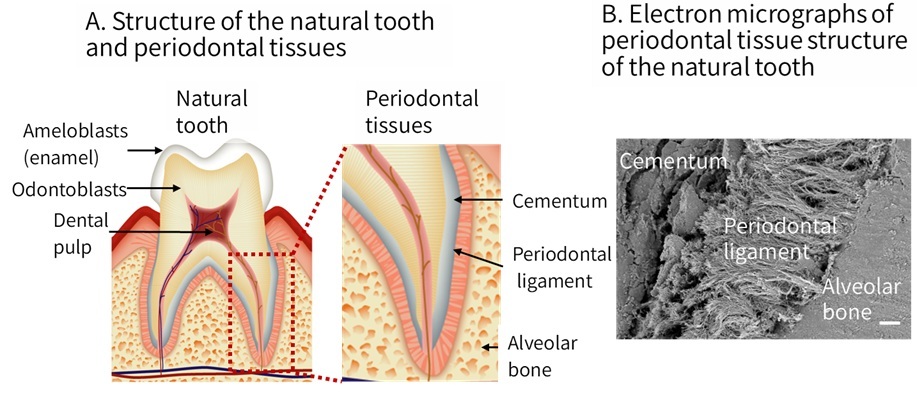
Within the oral cavity, teeth are supported by the periodontal ligament (Figure 3). The periodontal ligament is a collagen fiber–rich ligament that connects the tooth to the alveolar bone. Sharpey's fibers penetrate both the cementum on the root surface and the alveolar bone of the periodontal tissues, thereby anchoring the tooth within the jaw (Figure 3B). The periodontal ligament exhibits diverse physiological functions, including absorption and distribution of occlusal forces during mastication, sensory perception of pressure and pain through innervating sensory nerves, and immune defense through the infiltration of immune cells. Notably, age-related and growth-associated tooth movement is mediated by bone remodeling regulated by the periodontal ligament, a principle that forms the biological basis of orthodontic treatment.
Dental diseases include dental caries, trauma, root fractures, and periodontal disease. According to surveys conducted by the 8020 Promotion Foundation, periodontal disease accounts for approximately 37% of permanent tooth loss, indicating that nearly 40% of tooth extractions are attributable to periodontal disease. Moreover, this proportion increases with age, and reports indicate that tooth loss due to periodontal disease becomes even more prevalent among older adults. Loss of teeth leads to deterioration of the functional occlusal system, significantly affecting eating, speaking, oral sensory perception, and oral hygiene. Thus, it is not an overstatement to say that the key to sustaining the ability to "eat using one's own teeth," which lies at the core of a healthy society, resides in the periodontal ligament.
